How a strategic specialist partner in clean power and grid services can play their part in data centre grid access
How a strategic specialist partner in clean power and grid services can play their part in data centre grid access by NTR’s Joe Dalton, Managing Director, Engineering and Asset Management
Data centres have become foundational to the modern digital economy. They host large‑scale computing, storage, and networking infrastructure that underpins cloud services and AI workloads. As these services rapidly expand, so does the energy footprint required to support them. Electricity consumption from data centres in Europe is forecasted to grow from 70 TWh in 2025 to more than 130 TWh by 2030—an increase of nearly 90%. And in certain markets, data centres are fast becoming the single biggest source of demand for electricity consumption, with their particular requirements putting strain on the grid systems.
Data centres demand continuous electricity supply, driven not only by computing workloads but by extensive cooling systems and the electrical infrastructure required to ensure uninterrupted performance. AI workloads intensify this challenge. They create instantaneous multi‑megawatt load swings, ten times more volatile than conventional data‑centre operations. These fluctuations can destabilise weak grids and contribute to voltage or frequency oscillations.
At the same time, grids are transitioning towards renewable energy sources, primarily wind and solar, which also connect through inverters rather than synchronous machines. The result is a structural reduction in system inertia. As data‑centre demand increases alongside renewables penetration, grid operators face an elevated risk of rapid system frequency disturbances, known as rate‑of‑change‑of‑frequency (RoCoF) events, and voltage instability that can lead to “potential oscillations”.
This combination of high growth, low inertia, and rapid load variability creates an unprecedented operational challenge.
Engineering for Extreme Reliability
Data centres are designed as highly resilient systems. Operators typically employ extensive redundancy, often referred to as N+1 architecture. This architecture can include multiple grid connections, independent cooling circuits, redundancy in uninterruptible power supply (UPS) systems and in on‑site backup generation (diesel or gas turbines).
Top-tier facilities aim for the “five nines”, 99.999% uptime which is equivalent to just minutes of downtime per year requiring sophisticated control systems, strict maintenance regimes, and engineered risk mitigation across all utility interfaces.
The Emerging Power-Capacity Crunch
The rapid expansion of data‑centre load is now colliding with other major factors including decarbonisation targets that limit new fossil‑fuel generation, grid congestion and a grid infrastructure that was not designed for high‑variability loads.
In major European hubs, grid capacity constraints are delaying new connections and prompting regulators and operators to reassess the role of data centres as active grid participants in system stability, rather than passive consumers. This places obligations on data centres that resemble those traditionally placed on electricity generators and increasingly, we are seeing conditional access being given to grid tied to the role the data centres need to play in proactive grid support.
The role of a specialist partner in clean energy and grid supporting services
Data centres continue to seek clean power alternatives to self-generating diesel or gas and in Europe, countries like Ireland and Germany have clearly tagged the ability for data centres to access grid to their ability to demonstrate that they are sourcing clean power, whether on-site or remotely.
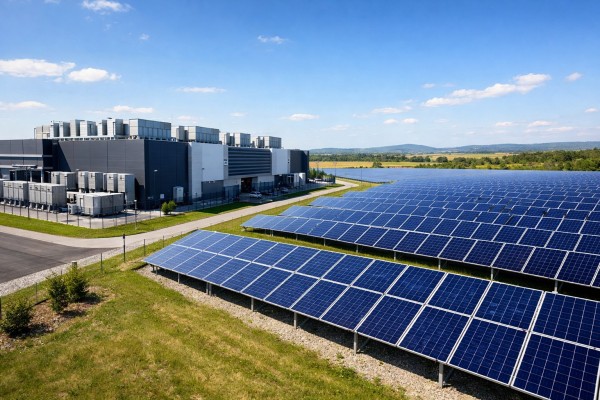
While traditional clean power PPAs will continue to play a role, clean energy projects that combine wind and solar energy together with co-location of battery storage can offer a viable solution for largely decarbonising data‑centre demand. Our analysis of clean energy parks in Northern Europe indicates that blended configurations can deliver up to 75–80% self‑supply on an hourly basis, at a levelised cost comparable to gas generation. The optimal configurations would involve high ratios of wind to solar (e.g., 3:1) in northern Europe, eight hours of battery storage and a modest overbuild to account for battery degradation.
However, clean power is just part of the picture. To fully integrate data centres into the evolving energy system, investment is required not only in clean power, but also in electrification-enabling infrastructure. Instead of being treated as passive energy consumers, data centres are increasingly expected to operate as system enablers for system operators, contributing to inertia provision, voltage and frequency support and dispatchable capacity.
Technologies are already available to enhance resilience, facilitate greater renewable integration, and allow data centres to contribute positively to system stability, especially during AI‑related load swings.
These technologies include:
Grid-Forming Converters
Enable batteries to behave like “virtual” synchronous machines by generating their own voltage source, to support weak grids, provide levels of fault current, and stabilise voltage waveforms.
Synchronous Condensers
Provide mechanical inertia, reactive power, fault current, and voltage stability. Critical for regions retiring conventional plants.
Advanced Power Electronics (E‑Statcoms)
Supercapacitor‑based systems capable of fast, high‑burst power delivery; effective for mitigating harmonic distortion and supporting rapid load changes.
Specialists in clean power and grid services, like NTR, can play a critical role as a strategic partner to facilitate the delivery of this new role as system supporter being placed upon data centre operators. With active experience in designing, building and operating energy and grid services systems, we can facilitate the data centre’s access to grid whilst enabling the data centre to focus on their own core business of delivering reliable, secure and scalable compute infrastructure.